

How Do Geographic Region Affect The Makeup Of Political Parties
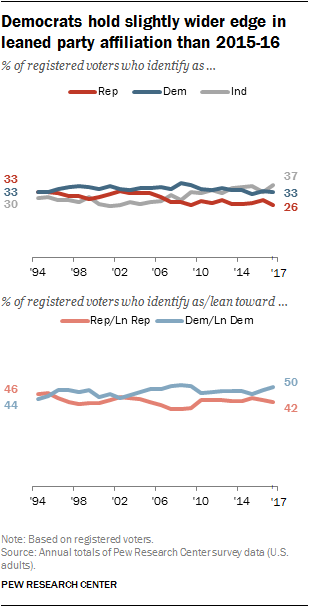 The residuum of partisan affiliation – and the combined measure of partisan identification and leaning – has non changed substantially over the past two decades. However, Democrats agree a slightly larger edge in leaned political party identification over Republicans now than in 2016 or 2015.
In Pew Research Center surveys conducted in 2017, 37% of registered voters identified every bit independents, 33% as Democrats and 26% as Republicans. When the partisan leanings of independents are taken into business relationship, 50% either place as Democrats or lean Autonomous; 42% identify equally Republicans or lean Republican.
The 8-percentage-point Democratic reward in leaned partisan identification is wider than at any betoken since 2009, and a statistically significant shift since 2016, when Democrats had a 4-betoken edge (48% to 44%). The analysis in this written report draws on more than ten,000 interviews with registered voters in 2017 and tens of thousands of interviews conducted in previous years (see Methodology for additional item).
There keep to be fundamental differences in the partisan orientation of unlike demographic groups, and in many cases these gaps accept grown wider in recent years. For instance, gender, generational, geographic and educational divides are at present as wide, or wider, than in Pew Enquiry Eye surveys going dorsum more two decades.
Wide gender gap in partisanship
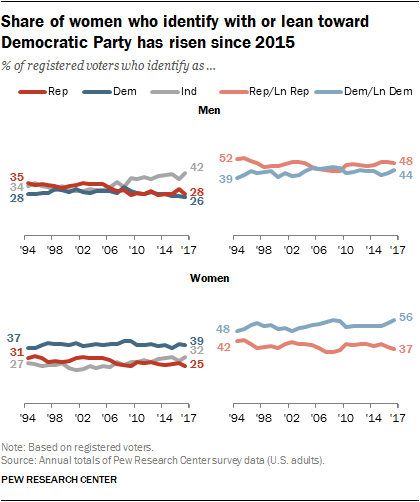 As has been the case for more than two decades of Pew Research Center surveys, women are significantly more than likely than men to associate with the Democratic Party. While the gender gap has inverse little in recent years, it is as wide as it has been at whatever point during this period: Amid registered voters, 56% of women affiliate with or lean toward the Democratic Party, compared with 44% of men.
From 2010 through 2015, about half of women (51%-52%) identified with or leaned toward the Democratic Political party. Merely the share of women who identify with or lean to the Autonomous Party has risen in recent years, to 54% in 2016 and 56% in 2017. The partisan breakdown of men is relatively unchanged over this catamenia.
The Democratic gains amid women have not come from increased affiliation with the party. Overall, the proportion of women voters who identify with (rather than lean toward) the Democratic Party has remained relatively constant for the past 25 years (in 1994, 37% of women said they identified with the Democratic Political party, compared with 39% in 2017).
Black, Hispanic and Asian voters remain overwhelmingly Democratic
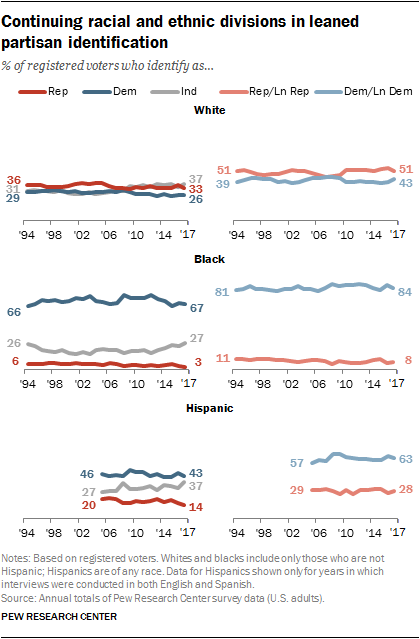 In that location are sizable and long-standing racial and ethnic differences in partisan affiliation, and they accept shifted only modestly in recent years.
White voters keep to exist somewhat more likely to affiliate with or lean toward the Republican Political party than the Democratic Political party (51% to 43%).
Since 2010, white voters accept been more probable to align with the GOP than with the Democrats. However, the share of whites identifying as Democrats or leaning Democratic has edged upwards (43% now, up from no more 40% from 2009 to 2016). This growth is attributable to a slight increase in Autonomous-leaning independents, rather than a ascent in Democratic affiliation.
Past contrast, African American voters remain overwhelmingly Autonomous: 84% identify with or lean toward the Autonomous Party. Just eight% of black voters place in some way with the Republican Party.
While black voters remain solidly Democratic, identification with the Democratic Political party has declined modestly in recent years: Nigh ii-thirds of African Americans have identified as Democrats in the last several years, down slightly from the first one-half of Barack Obama's presidency, when about 3-quarters affiliated with the Democratic Political party.
Past more than two-to-one (63% to 28%), Hispanic voters are more likely to chapter with or lean toward the Democratic Party than the GOP. The overall residual of partisan orientation among Hispanics is fiddling changed over the last decade.
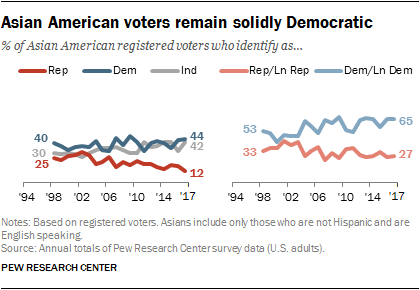
At that place is a similar balance of partisanship among Asian American registered voters: 65% place with the Autonomous Political party or lean Democratic, compared with 27% who identify equally or lean Republican.
In 1998 (the first year for which sample sizes of Asian American voters were sufficiently large enough in Pew Research Center surveys), 53% of Asians identified with or leaned toward the Democratic Party and 33% identified with or leaned toward the Republican Party. (Notation: Only English-speaking Asian American voters are included in the information).
The share of Asian American voters who identify equally Republican is at present only 12%. While this is little inverse in the last few years, information technology represents the continuation of a longer trend in declining Republican affiliation among Asian voters. Among Asians, identification with the Democratic Party has remained relatively stable over this period. The share of Asian voters who say they are political independents has risen steadily since 1998, reflecting a more than general trend among all voters.
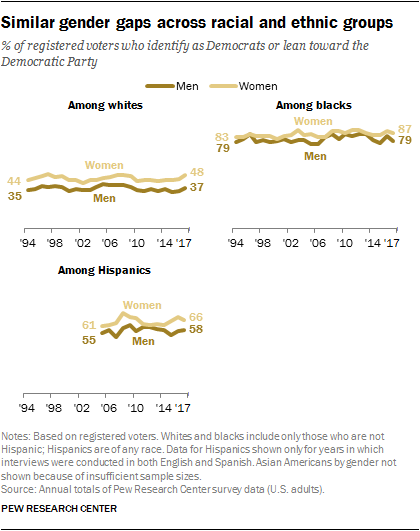
A gender gap in partisan amalgamation and leaning is seen across racial and indigenous groups.
For instance, there is a 9-per centum-point gender gap among white voters: While 48% of white women affiliate with or lean toward the Democratic Party, 37% of white men do so. Similarly, there is an 8-indicate gender gap among black voters (87% of black women vs. 79% of black men), as well as among Hispanic voters (66% of women vs. 58% of men).
Educational gap in partisan orientation continues to grow
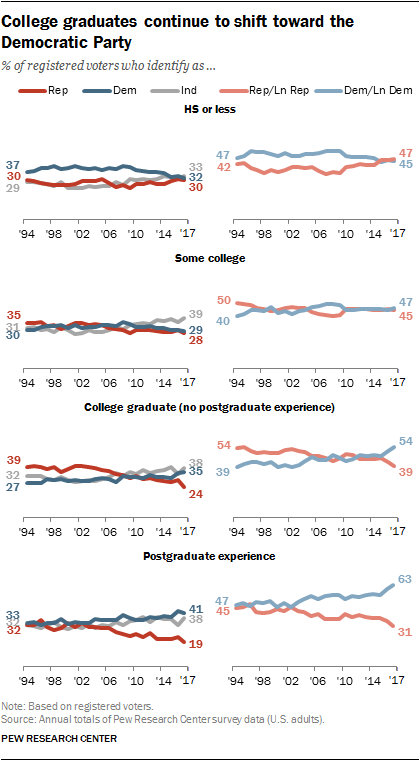 Higher educational attainment is increasingly associated with Democratic Party affiliation and leaning. At the same fourth dimension, those without college experience – once a grouping that tilted more Democratic than Republican – are roughly divided in their partisan orientation.
These twin shifts have resulted in the widest educational gap in partisan identification and leaning seen at any point in more than ii decades of Pew Research Center surveys.
In 1994, 39% of those with a four-year higher degree (no postgraduate feel) identified with or leaned toward the Democratic Party and 54% associated with the Republican Party. In 2017, those figures were exactly reversed.
Democratic gains have been even more pronounced among those who pursue postgraduate education. In 1994, those with at least some postgraduate feel were evenly split betwixt the Autonomous and Republican parties. Today, the Autonomous Party enjoys a roughly ii-to-1 advantage in leaned partisan identification. While some of this shift took place a decade agone, postgraduate voters' affiliation with and leaning to the Autonomous Party have grown substantially only over the past few years, from 55% in 2015 to 63% in 2017.
By contrast, Republicans accept been gaining ground over the by several years with those who do not take bachelor's degrees. Amid those with no more than a high schoolhouse instruction, 47% chapter with the GOP or lean Republican, while 45% identify as Democrats or lean Democratic. Democrats held a significant advantage among voters with a high school degree or less didactics for much of the belatedly 1990s through early on 2000s, and every bit recently equally 2014 (47% Democratic, 42% Republican).
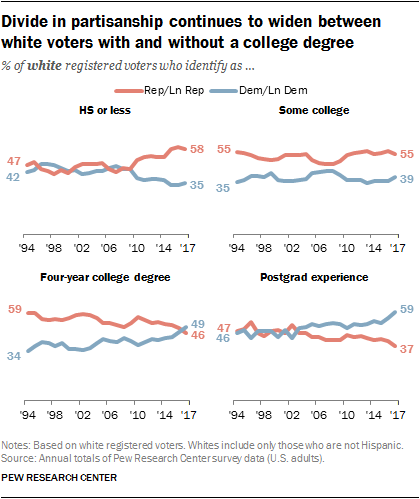 These overall patterns in instruction and partisanship are particularly pronounced among white voters. While the GOP has held meaning advantages over the Democratic Political party amongst white college graduates without postgraduate feel over much of the by two decades, these voters are divided in their partisanship today.
In 2017, 49% of white voters with a higher degree (and no additional educational activity) aligned with the Autonomous Political party, compared with 46% for the GOP. Equally recently as 2015, 51% of white voters with a higher caste aligned with the Republican Party, compared with 43% for the Democratic Party.
And amidst voters with postgraduate experience, the Democratic reward has grown. In 2017, 59% of white voters with at least some additional instruction beyond a 4-year caste identified every bit Democrats or leaned Democratic, while 37% identified with or leaned toward the Republican Political party; every bit recently as 2015 that balance was slightly narrower (52% to 41%).
By dissimilarity, white voters with no more a high school education accept moved more to the GOP over the concluding 10 years, though there has been picayune change since 2015. As recently equally 2009, these voters were divided in leaned partisanship. Since so, Republicans take held significant advantages, including a 23-pct-point lead in 2017 (58% Republican, 35% Democratic).
A wide – and growing – generational separate in partisanship
 The generational gap in partisanship is now more pronounced than in the past, and this echoes the widening generational gaps seen in many political values and preferences.
Millennial voters (born 1981 to 1996) have had a Democratic tilt since they kickoff entered adulthood; this advantage has but grown as they have aged.
Democrats relish a 27-percentage-point advantage among Millennial voters (59% are Democrats or lean Democratic, 32% are Republican or lean Republican). In 2014, 53% of Millennial voters were Democrats or leaned Democratic, 37% tilted toward the GOP.
Millennials remain more likely than those in older generations to call themselves independents (44% vs. 39% of Gen Xers, 32% of Boomers and 27% of Silents); nonetheless, the roughly two-to-i Autonomous reward amidst Millennials is apparent both in "straight" and "leaned" partisan affiliation.
Generation X voters (built-in 1965 to 1980) are more divided in their partisan attachments, just also tilt toward the Democratic Party (48% identify every bit or lean Democratic, 43% identify as or lean Republican). The rest of leaned partisan identification amid Gen X voters has been relatively consistent over the past several years. Baby Boomer voters (born 1946 to 1964) are well-nigh evenly divided (48% place as or lean Democratic, 46% Republican).
The Silent Generation (born 1928 to 1945) is the only generational group that has more than GOP leaners and identifying voters than Democratic-oriented voters. Almost half (52%) of Silent Generation voters identify with or lean toward the Republican Party, a larger share than a decade agone; 43% place with or lean toward the Democratic Party.
 While at that place is a gender gap in partisan affiliation within every generational cohort, it is peculiarly pronounced among Millennial voters. A big majority of Millennial women (70%) identify with or lean toward the Autonomous Political party, compared with 49% of Millennial men.
This wide gender gap amongst Millennial voters is largely owing to a marked shift among Millennial women. Equally recently as 2014, the Democratic reward amid Millennial women was a narrower – merely still substantial – 21 percentage points, compared with 47 points today. The balance of partisanship amidst Millennial men was similar in 2014 as it is today (50% Democratic vs. 40% Republican).
 Gender gaps in other generations are more modest. For instance, 57% of Silent Generation men identify with or lean toward the GOP, compared with 48% of Silent women.
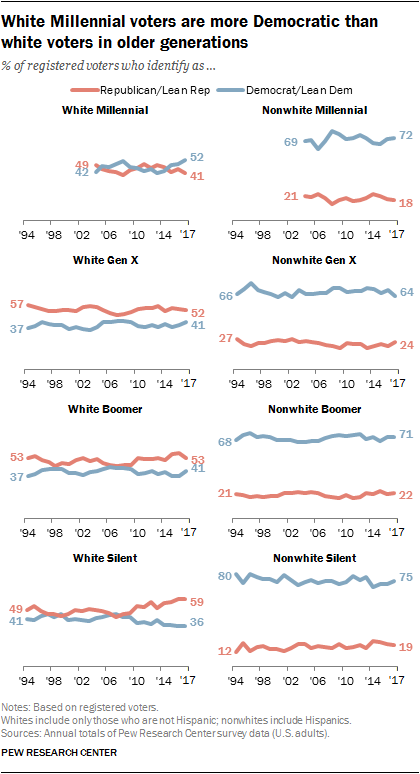
Across all generations, nonwhite voters are overwhelmingly Democratic in their leanings, while whites are more than divided. Amidst white voters, Millennials are the only generation in which the share of Democrats and Democratic leaners (52%) is greater than the share of Republicans and Republican leaners (41%).
Amid older generations of whites – but particularly among white Silents – more voters align with the GOP than the Democratic Party.
White Silent Generation voters have moved toward the GOP in recent years. Today, 59% identify with or lean to the GOP, up from 43% a decade ago.
White Gen Xer and Boomer voters accept remained relatively stable in their partisan makeup in recent years. In both generations, the GOP enjoys a similar modest advantage (11 percentage points amongst white Gen Xers, 12 points amid white Boomers); these are similar to the balances in 2014.
Religious amalgamation and political party identification
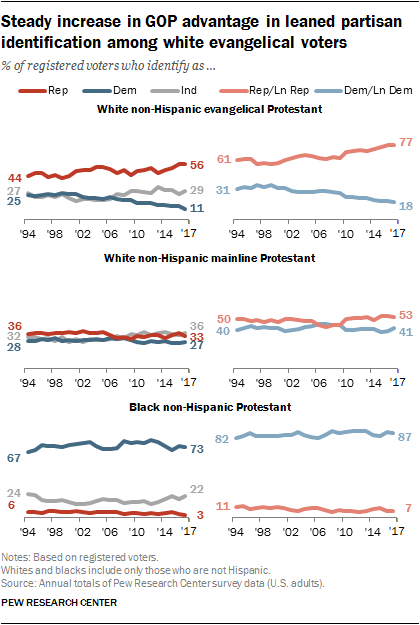 White evangelical Protestants remain one of the most reliably Republican groups of voters, and the GOP's advantage among this segment of the population has continued to grow in recent years: 77% of white evangelical voters lean toward or identify with the Republican Party, while just eighteen% take a Autonomous orientation.
White mainline Protestant voters are more divided in their political identities. Every bit has been the instance for the last several years, a narrow majority (53%) affiliates with or leans to the GOP, while 41% lean toward or identify with the Democratic Party.
Black Protestant voters remain solidly Democratic in their partisan loyalties. Almost nine-in-ten (87%) lean toward or identify with the Democratic Party.
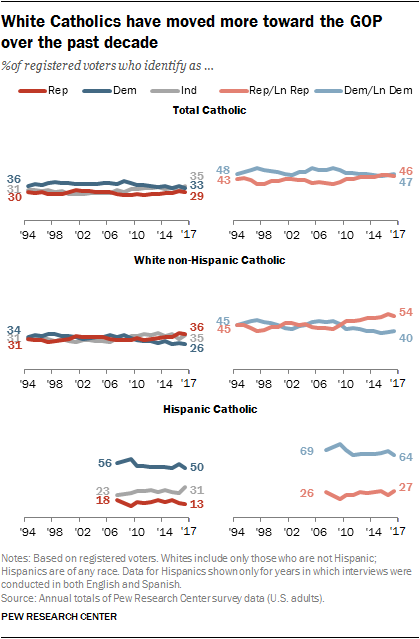 Overall, Catholic voters are roughly evenly split between the share who place with or lean to the Republican (46%) and Democratic (47%) parties. But white Catholics and Hispanic Catholics diverge politically.
White Catholic voters now are more Republican (54%) than Democratic (forty%). While the partisan balance among white Catholic voters is little changed in recent years, this group was more evenly divided in their partisan loyalties nearly a decade ago.
Hispanic Catholics, who represent a growing share of the Catholic population in the U.Southward., are substantially more Democratic in their orientation (64% of Hispanic Cosmic voters chapter with or lean to the Democratic Political party, 27% to the GOP).
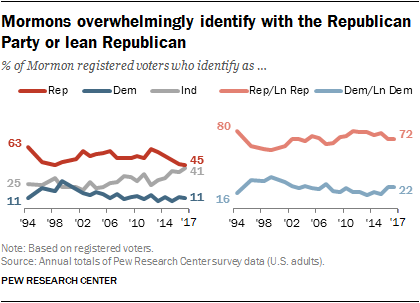 While Mormon voters remain a solidly Republican grouping (72% overall are Republican or Republican leaning), in recent years Mormons accept been less probable to identify every bit Republican than in the by.
Mormon voters are now most every bit likely to identify as independent (41%) equally they are to place as Republican (45%). For about of the by two decades, majorities of Mormons called themselves Republicans.
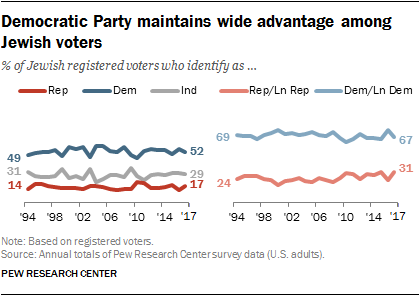 By about 2-to-one, Jewish voters continue to identify with or lean toward Democratic Party (67% vs. 31% who identify with or lean Republican). This balance is piffling inverse over the terminal decade.
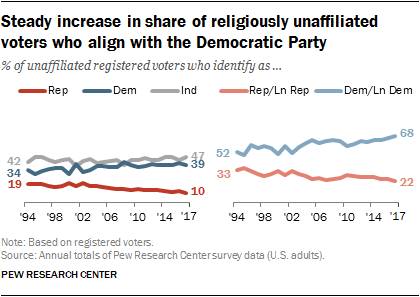 The religiously unaffiliated, a growing share of the population, have shown steady motion in orientation toward the Autonomous Party. In 1994, about one-half (52%) of religiously unaffiliated voters leaned toward or identified with the Democratic Party. Today well-nigh 7-in-10 (68%) exercise so.
Urban voters grow more Democratic, rural voters more Republican
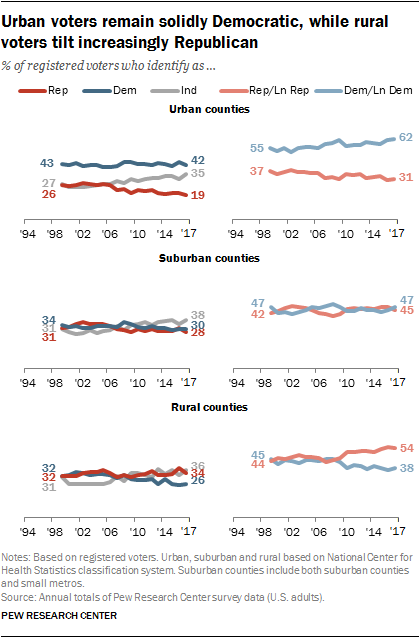 Voters in urban counties have long aligned more with the Democratic Party than the Republican Party, and this Autonomous reward has grown over fourth dimension. Today, twice as many urban voters identify equally Democrats or lean Democratic (62%) as affiliate with the GOP or lean Republican.
Overall, those who live in suburban counties are about evenly divided in their partisan loyalties (47% Autonomous, 45% Republican), little inverse over the last two decades.
Voters in rural areas have moved in a more Republican direction over the terminal several years. From 1999 to 2009, rural voters were about every bit divided in their partisan leanings. Today, there is a sixteen-percentage-point reward for the GOP among rural voters.
While there are racial and ethnic differences in the makeup of rural, suburban and urban areas, this overall blueprint of geographic difference is also seen amongst whites. Amongst rural whites, the GOP enjoyed a roughly ten-percentage-indicate advantage throughout much of the 2000s; the GOP advantage among rural white voters is now 24 percentage points (58% to 34%). At the same time, while urban white voters were roughly evenly divided in their political preferences for much of the concluding two decades, in recent years the Democratic Party has enjoyed a double-digit partisan reward: Today, 54% of white urban voters are Democrats or lean Autonomous, while 41% identify with the GOP or lean Republican.
Source: https://www.pewresearch.org/politics/2018/03/20/1-trends-in-party-affiliation-among-demographic-groups/
Posted by: johnsonyousterromme.blogspot.com
0 Response to "How Do Geographic Region Affect The Makeup Of Political Parties"
Post a Comment