

Do You Draw Arrows At The End Of A Line Of Best Fit
Physics Practical Skills Part four: Drawing graphs and lines of all-time fit
In part 4 of the Physics Skills Guide, we explain how to draw a line of best fit correctly in Physics Practicals. Read the postal service to learn virtually dos and don'ts of drawing a line of best fit.
Introduction to Cartoon Graphs and Lines of Best Fit
In this Guide, nosotros explicate the importance of scientific graphs in Physics and how to draw scientific graphs correctly including lines of best fit. This is a really important Physics skill and you'll need to master it if yous want to ace your next Physics Practical test.
In this article nosotros hash out:
- Scientific graphs
- Drawing the line of all-time fit
- Common mistakes with drawing lines of best fit
Want to ace your adjacent Physics Practical Assessment?
Learn how to:
- Assess the validity, reliability and accurateness of whatsoever measurements and calculations
- Determine the sources of systematic and random errors
- Identify and apply appropriate mathematical formulae and concepts
- Draw appropriate graphs to convey relationships
with the Matrix Practical Skills Workbook.
Sharpen your Physics skills
Get exam-ready for your Physics practical assessments with this free prac skills workbook.
Your workbook is on the way! Cheque your electronic mail for the downloadable link. (Please permit a few minutes for your download to land in your inbox)
DOWNLOAD YOUR FREE SKILLS WORKBOOK
Scientific Graphs
What are scientific graphs?
A graph is a visual representation of a relationship between two variables, x (the contained variable) and y (the dependent variable).
Graphs go far piece of cake to place trends in data that you have collected and can be analysed in order to perform a calculation or a measurement, related to addressing the aim of an experiment.
How to draw a scientific graph
| Step | Action | Detail |
| 1 | Place the variables |
|
| two | Make up one's mind the variable range |
|
| three | Determine the scale of the graph |
|
| 4 | Number and label each axis |
|
| 5 | Plot the information points |
|
| 6 | Draw the graph |
|
| 7 | Provide a descriptive title |
|
In Twelvemonth 11 and 12 Physics, the trends that you will investigate are generally linear, or can be converted into linear graphs, and, hence, you'll be required to draw a line of best fit.
Drawing the line of best fit
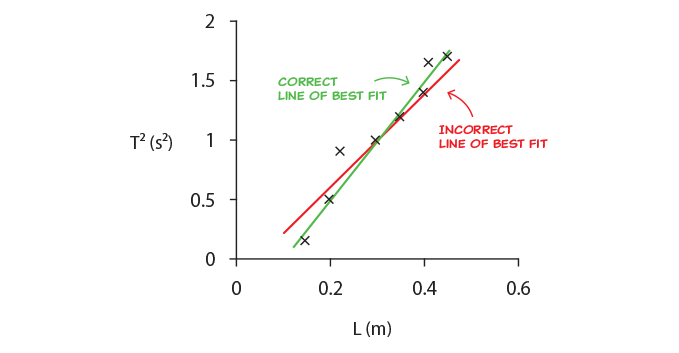
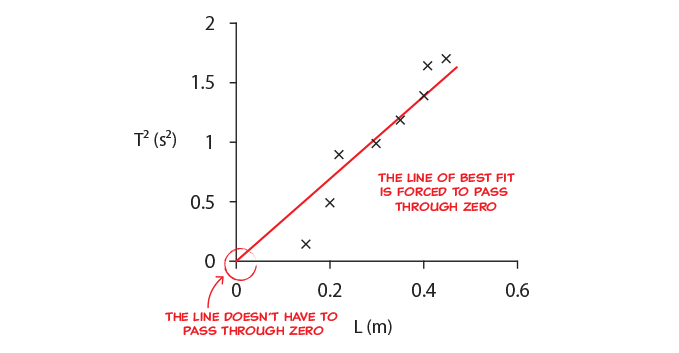
An example of a correctly drawn line of best fit is shown below, along with an incorrect i:
How to draw a line of best fit
To depict the line of best fit, consider the following:
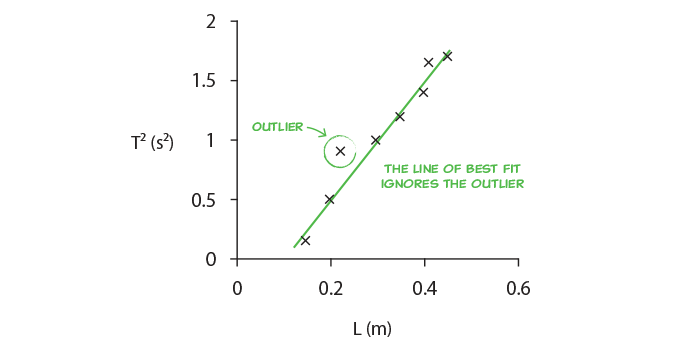
- Outliers must be ignored.
- The line must reflect the trend in the data, i.east. it must line up best with the majority of the data, and less with data points that differ from the bulk.
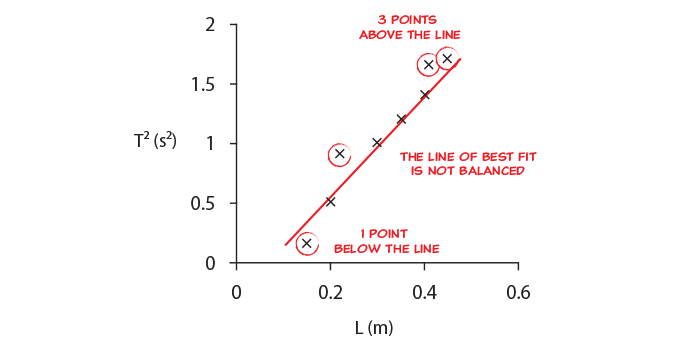
- The line must exist balanced, i.e. it should have points above and below the line at both ends of the line.
- Do Non force the line to laissez passer through whatever specific data points, or to pass through nada. The purpose of the line of best fit is to reveal the trend of all the data.
Why do we need to draw a line of best fit?
The master reasons for drawing a line of best fit are to:
- Reduce the effect of both systematic and random mistake and thus make the experiment more accurate and more reliable.
- Find and utilize the gradient of the line of best fit to determine an unknown in the experiment. Ordinarily determining this unknown addresses the aim in some way
How does the line of all-time fit reduce experimental errors?
Past drawing the line of best fit we are looking for the strongest trend in the data, and in this manner reduce the effect of random errors. If nosotros then use the gradient of the line of best fit we expect at differences in values rather than accented values, which reduces or eliminates the upshot of systematic errors.
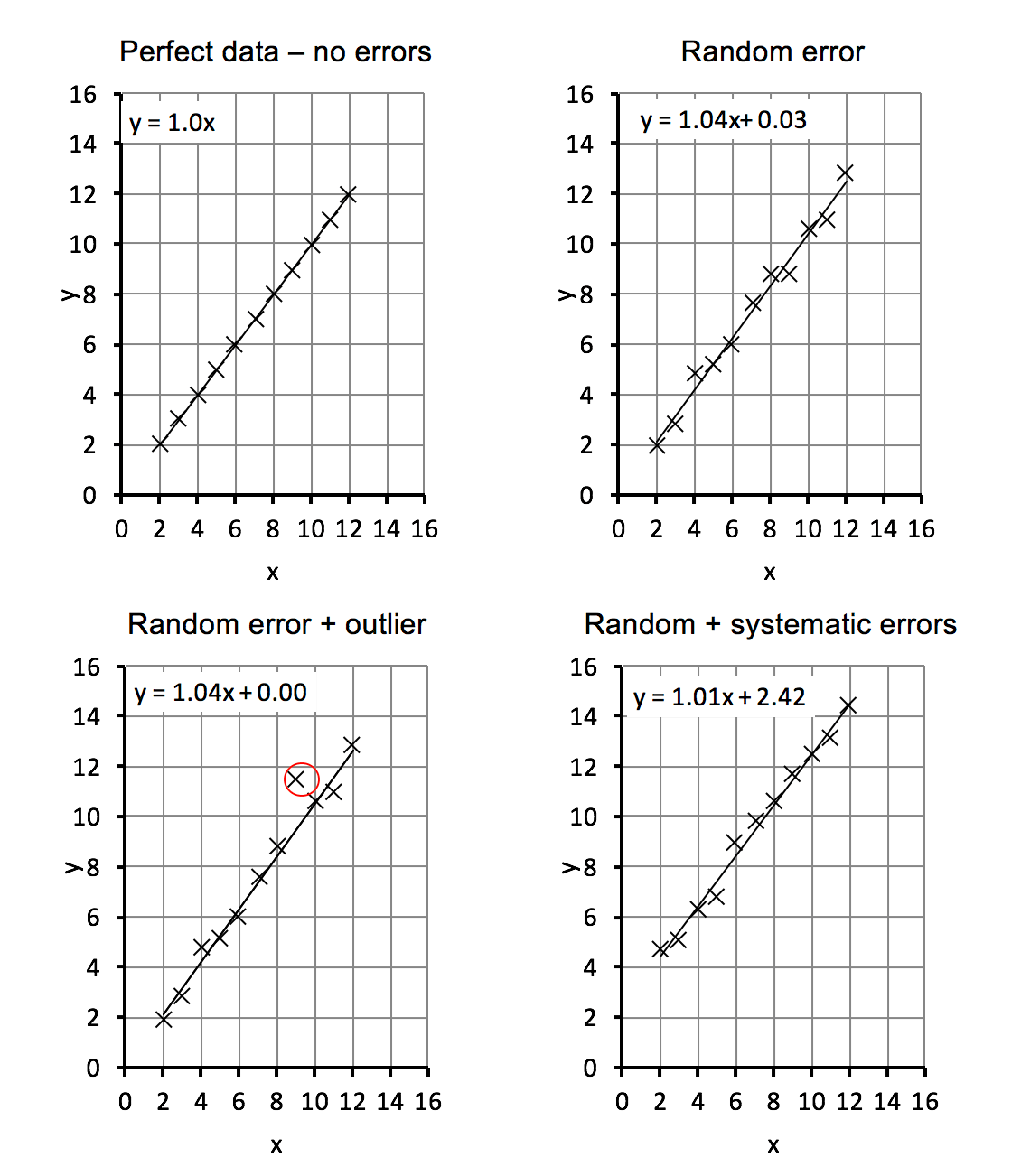
The graphs below illustrate four examples with different types of errors and with no errors:
- Perfect information with no errors
- Random error
- Random error with outlier
- Random and systematic errors
The gradient represents the result of the experiment and should have a value of ane, so the equation of the line is \(y=x\).
How does using a line of best fit reduce experimental errors?
Using a graph gives results that are as expert or meliorate than calculating from the data points direct and then averaging, as shown in the table below.
| Types of error present | Effect obtained from the gradient of a line of best fit | Result obtained from computing using all information points and averaging them |
| Perfect data – no errors | one.00 | 1.00 |
| Random error | 1.04 | 1.04 |
| Random error with outlier | ane.04 | ane.07 |
| Random and systematic errors | ane.01 | ane.47 |
From the table, we tin can run across that:
- The perfect data has a gradient of 1.
- The random error gives a gradient is 1.04, still very shut to the correct value of 1.
- The outlier is ignored by the line of best fit, so the gradient is still 1.04, close to the correct value. Averaging over the data points would not ignore the outlier and would give a worse result of one.07.
- The systematic error shifts up the information by the same corporeality but does not change the gradient, which is still 1.01. This is withal very shut to the correct value of 1.Still, averaging over the points, in this case, gives an incorrect answer of i.47.
Common mistakes with drawing lines of best fit
The example beneath shows mutual mistakes by students when drawing lines of best fit. The exact mistakes the students have fabricated are listed below.
Mistake 1: Missing labels
Graph i shown beneath is missing labels:
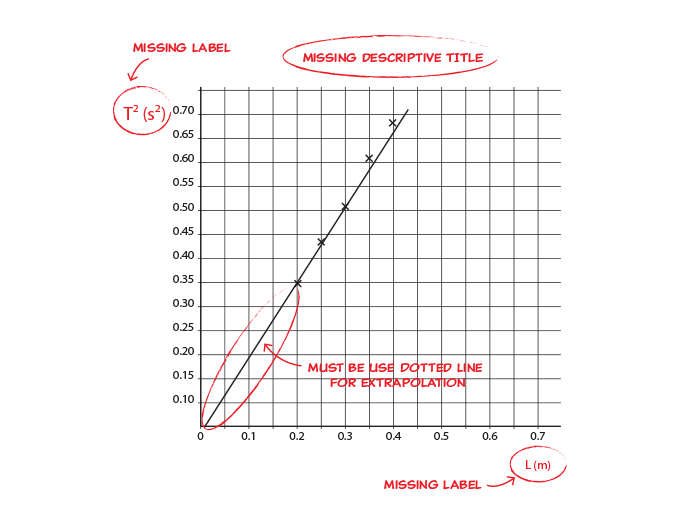
Mistakes in this graph include:
- Missing labels for the axes
- Missing descriptive title
- The extrapolated line is not drawn using a dotted line
six Common Mistakes HSC Physics Students Make in Exams
Mistake 2: Incorrect scale
Graph 2 shown beneath contains an incorrect calibration:
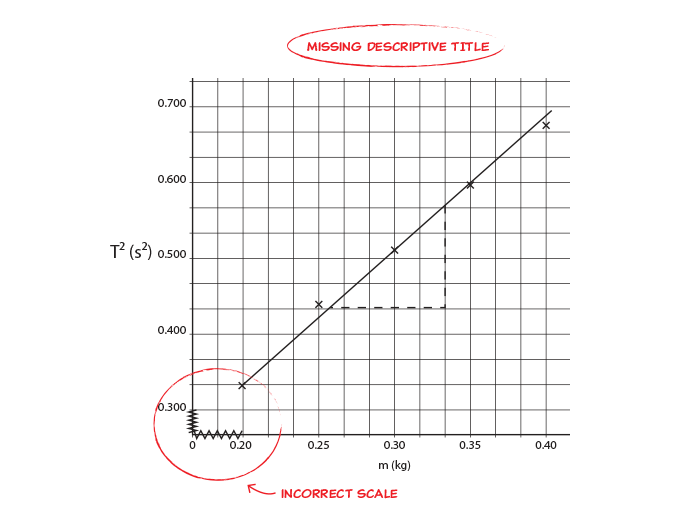
Mistakes in this graph include:
- Incorrect calibration in ten and y-axes. Each segmentation should represent the same value across each axis. For instance, if each segmentation is set a value of 0.05 at the start of the graph for that axis, then i sectionalisation should always represent 0.05 for that axis.
- The student should either start the calibration at 0 or at 0.20 on the x-axis.
© Matrix Education and www.matrix.edu.au, 2022. Unauthorised employ and/or duplication of this material without express and written permission from this site's writer and/or owner is strictly prohibited. Excerpts and links may be used, provided that full and articulate credit is given to Matrix Education and www.matrix.edu.au with appropriate and specific direction to the original content.

Source: https://www.matrix.edu.au/the-beginners-guide-to-physics-practical-skills/physics-practical-skills-part-4-how-to-draw-a-line-of-best-fit/
Posted by: johnsonyousterromme.blogspot.com
0 Response to "Do You Draw Arrows At The End Of A Line Of Best Fit"
Post a Comment